
Cosmos as a Vibrating Bundle of Worldlines
Quantum Gravity on the Complex Hopf Fibration

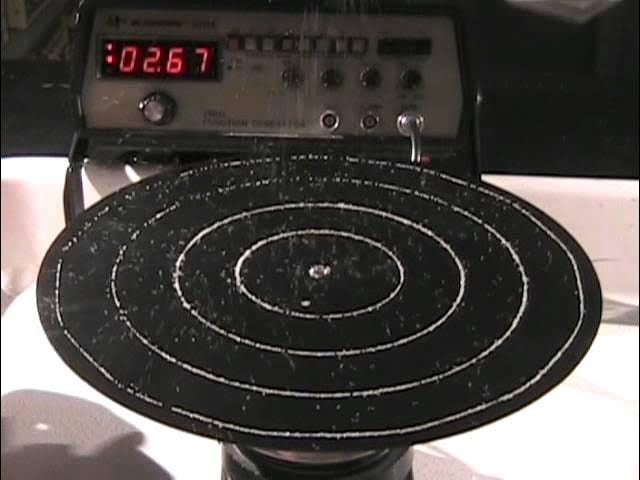
Imagine a vibrating plate covered in sand.
As the plate vibrates, something magical happens. The sand starts to move — and then, suddenly, patterns form. Circles, spirals, grids, starbursts!
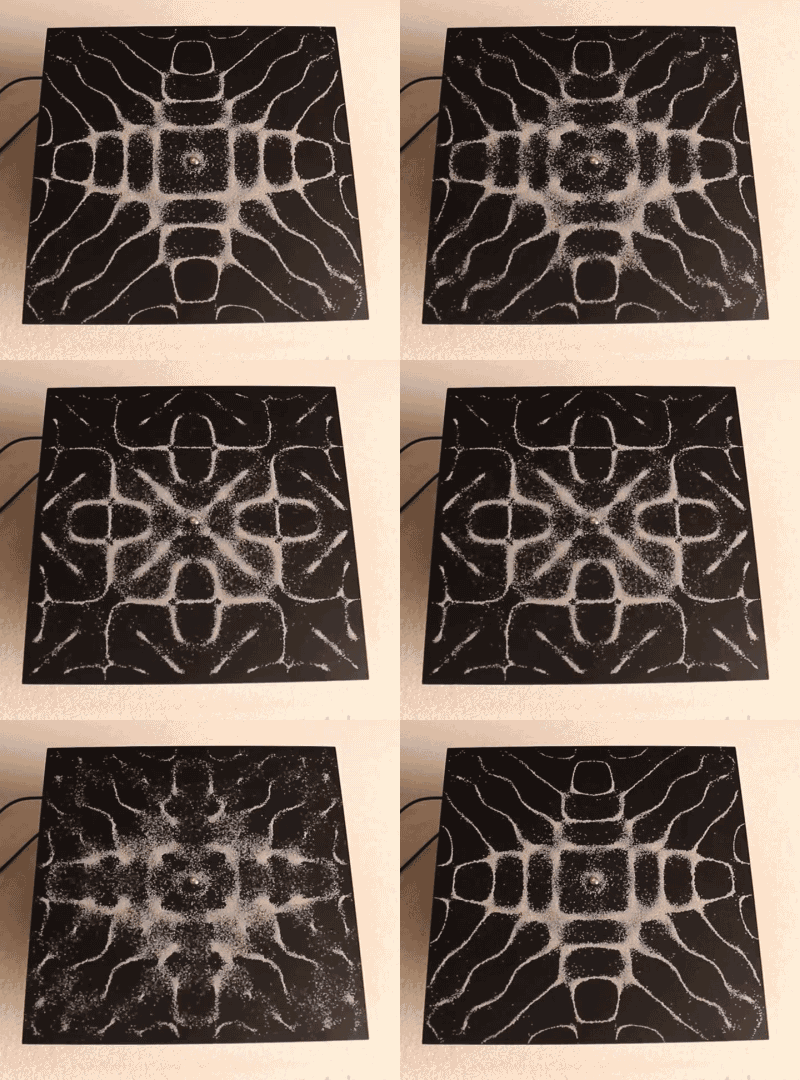
As the vibration is turned up faster and faster, more intricate and detailed shapes appear. As the vibration slows down, the patterns become simpler. This is called the cymatics experiment, and it’s a real science: cymatics is the study of how vibrations make visible patterns in matter.
Take a minute to watch the video by Brusspup below that shows this experiment in detail. It’s beautiful and I hope you get lost in it for a couple of minutes! ☺️
Shapes form in the vibrating sand. As the vibration is turned up faster and faster, more intricate shapes form in the sand. As the vibration is turned down slower, the shapes get more simple / less complicated. This is called the cymatics experiment. Cymatics is the study of how vibrating matter forms standing wave patterns.
How does this work?
The sand doesn’t just move randomly — it follows the vibrations on the plate. The vibrations form standing waves, and these waves have special regions called nodes and antinodes. Nodes are the parts of the plate that don’t move at all — they’re perfectly still. Antinodes are the places where the vibration is strongest — they move up and down very quickly.
Because of this, the sand collects at the nodes — the quiet spots — and is thrown away from the antinodes — the loud, active regions. That’s why you see the beautiful shapes: the patterns trace out the still/quiet parts of the wave, the places where motion cancels out, and the sand is free to settle.
In this way, the sand builds up along nodal lines, tracing out the stationary regions of the standing wave pattern. The cymatics plots out a visual map of standing wave interference patterns — it’s as if the vibrating surface “draws” its own vibrational mode (where a mode is a state of the standing wave).
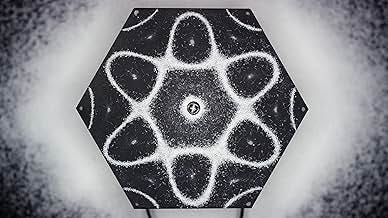
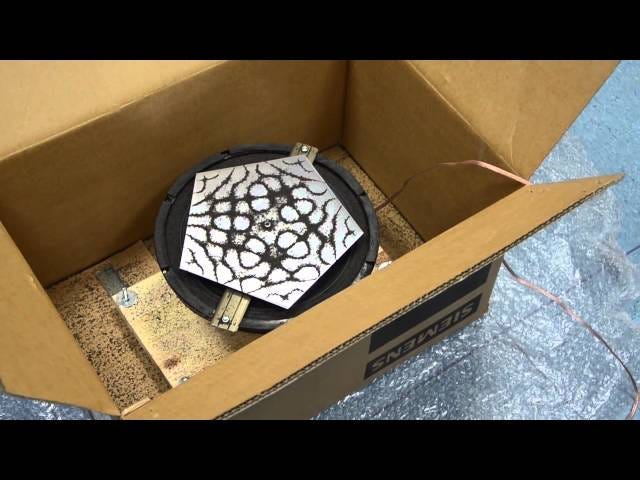
You can also change the patterns by changing the shape of the plate, like from a circle to a square or to a heart or hexagon. The shape of the plate affects the standing wave patterns, the same way the shape of a drum impacts the sound it makes. The constraints or boundary conditions imposed by the shape of the edges of the plate change what shapes of structures are allowed to form on the plate’s surface.
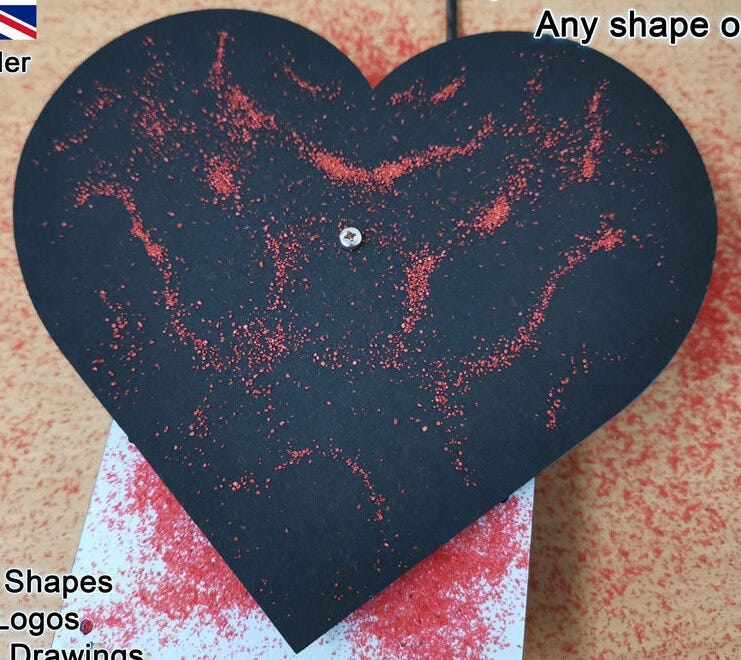
Heart-Shaped Vibrating Plate
If you change the shape a lot, the patterns change a lot.
Now, imagine, instead of a plate coated in sand, we have a vibrating ball of yarn.
Yes I know this is weird! Stay with me…
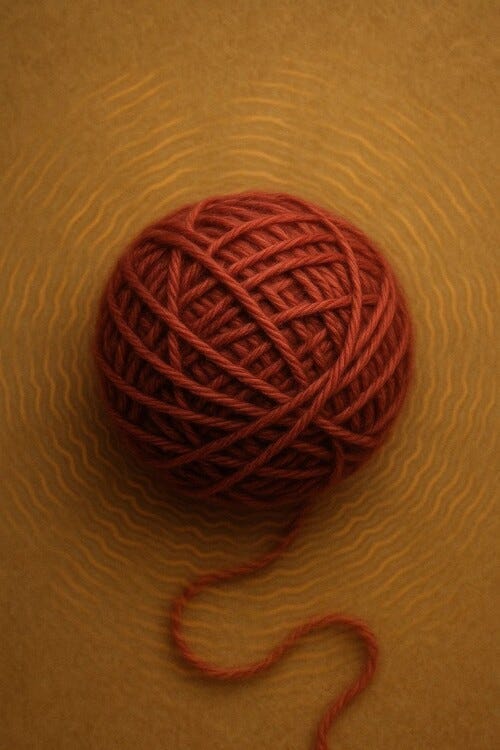
This vibrating ball of yarn makes up the topology or shape of the surface of the Master Space-Time Field Bundle.
The Master Space-Time Field Bundle actually looks a little more like the Hopf fibration depicted below:
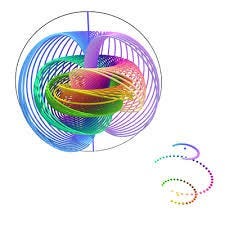
The Hopf fibration is just a mathematical plot of a bundle of circular fibers wrapped around a tiny ball. People try to make it complicated, but that’s really all it is! You can learn more about the Hopf fibration in the video below if you have fifteen minutes or so to spare:
But for now, let’s keep imagining the space-time field as a yarn ball, because that’s even simpler.
Yarn, of course, is fuzzy, so you can imagine lots of fuzz is stuck to the surface of the yarn ball. As the yarn ball vibrates, the fuzz vibrates on the surface of the ball.
Antinodes of maximal vibration represent regions where the spacetime field of the Master Space-Time Field Bundle is most coherent/strong/self-stable — these are areas of high constructive interference (and low or zero destructive interference) where the field is strongest. These are the areas where the field vibrates the hardest, where all the vibration “lines up” to make the field vibrates a certain way. (Remember that these are the areas where sand is kicked up and away from the plate in the cymatics experiment!) In these vibrating areas, excess fuzz on the surface of the yarn ball is shaken away and falls off.
Nodes represent areas of high destructive interference — these are areas where the field strength is lowest, where the field is decohered / breaking down because the vibration isn’t lining up; the vibration cancels and becomes still. (Remember that these are the areas where sand collects in the cymatics experiment!) In these areas, the fuzz of the yarn sticks in place because this part of the yarn is still and there is no vibration to shake it off and away.
These less coherent regions are also the regions of the bundle that are the most twisted up.
In less twisted or smoothly twisted regions, the field lines (fibers of the yarn) are aligned and in order without overlapping, so the fibers line up with one another. This allows the standing wave pattern to settle into stable antinodes with a coherent, aligned, strong field. These are areas where the gauge field of the Master Space-Time Field Bundle is strongest. (The gauge field shows you how the orientation of a particle varies as it moves; if you’ve taken physics, it’s similar to a vector field. If you haven’t, that just means a field of points where the points in the field track properties and directions of something.) I’s an “anti”-node because it repels things.
In more twisted or tangled local areas, the fibers wind and wrap more chaotically and sometimes get tangled up. This disordered tangle disrupts the regular wave pattern, causing destructive interference or decoherence. So the field fluctuates more irregularly, breaking down into noisy interference breakages in the field.
Just as sand collects in the node regions of the cymatics experiment, and fuzz sits on the surface of the yarn ball in the same areas, particles form and collect in these tangled and twisted regions of the Master Space-Time Field Bundle. But these particles are interesting because they are like little dips or little holes in the field, areas where the yarn threads break and tear, areas where the thread itself becomes shredded into fuzz--and this fuzz becomes the structured noise where the field destructs andpartially breaks down. These bits of fuzz are the particles in the field!
The twisting of the yarn around the bundle shapes how the particles form, separate from the basic field, and move.
Gravity (and mass) corresponds to curves/twists in the yarn ball structure, and gravity accompanies particles because particles have mass. Particles are forced to wind a certain direction around the yarn ball and this direction of the twist forms the arrow of time of particle motion.
So, the direction of the winding tells the particle which way to move through time. Each thread or fiber tells the whole story of what is happening to the fuzz at any given time. This means each thread is also a timeline/worldline. (Yes I know the fuzz metaphor is getting stranger, but try to hang on.)
Time is complex in the yarn bundle. Since the whole fiber is always present for all eternity, you can scan each whole fiber to check what was happening at other times and what is allowed to happen in the future. And you can check alternate fibers alongside each timeline fiber to see another possibility that might have happened if a fiber shredded or tangled slightly differently. Closer fibers are easier for a piece of fuzz / particle to jump to when something in an overall configuration changes, so each potential timeline is “weighted” as more or less likely given what has happened to the fuzz already.
Different features of the yarn ball also correspond to different parts of the Master Space-Time Field Bundle, and to different forces of nature.
The simplest twist corresponds with electromagnetism as a force in the field; physicists label this twist “U(1)”. A double-winding (two circular fibers) with a special rotation corresponds to the weak nuclear force which gives quarks their “flavor” (where flavor means unique combination of mass and charge for that type of quark); physicists label this kind of twist “SU(2)”. A triplet of fibers wound tightly so that the volume of the bundle part within it stays constant over three loops represents the strong nuclear force which holds the core of an atom together; physicists call this type of twist “SU(3).”
Get Jenny Lorraine Nielsen’s stories in your inbox
Join Medium for free to get updates from this writer.
Subscribe
All of these forces operate via the single field. This is what is meant by a unified field — multiple threads, one yarn ball.
Now, imagine this whole twisty timey-wimey yarn ball is wrapped and wound around a ping-pong ball.
This ping-pong ball is the base space of the Master Space-Time Field Bundle — it helps you track what part of the yarn touches which point on the ball. If you poke a needle through the ping-pong ball, it always will touch a particular selection of loops of the yarn. You could always poke through the ping-pong ball to touch any area of string on the yarn ball.
While we can use the direction along the fiber to represent time, the distance from the ping-pong ball to the fiber location can represent a point in 3D space the paticle is moving at.
This means you can draw a map on the ping-ball showing how the yarn is wrapped and plot every space-time coordinate on the entire yarn ball. This base space helps us make sense of the whole system. It’s a way of mapping the universe’s structure from the inside out!
The yarn ball we’ve been discussing is multidimensional.
We have a dimension of evolving duration / clock time along the fiber (our friend “t”). This comes in two flavors.
We have a dimension of whole fiber time in “eternity” space (looking at the whole fiber/entire worldline). One version of t gets paired with this complex time dimension to describe a duration along a worldline.
We can look at how the fibers cycle to consider elements of time that repeat, and call that “cyclic time” which gives us a third complex time dimension. Another version of t gets paired with this second complex time dimension to track durations of cycles. So that’s 4 total dimensions of time.
We also have regular 3D space. That’s three more dimensions, giving us 7D to work with.
We have a parameter we can call the “gauge” dimension, topological field structure dimension, which sweeps over and describes the overall shape of the bundle. So that’s 8D to work with.
We have the dimension of the fiber itself and its twisting/turning/winding. This is our 9th dimension. So now we have 9D total to work with.
(These 9D variables aren’t a perfect way to explain all the dimensions of the yarn ball, but they do describe how we can try to track those dimensions.)
So what we have now is the Topological Unified Field Theory.
It’s topological because it’s described by a surface of a shape, it’s unified because it has all the forces including gravity described all together, it’s a field because it describes a vast mapping of points, and it’s a theory because nothing in its hypothesis conflicts with any known experimental data.
The theory describes a 9D bundle (called S⁹ for 9D sphere) which represents all of space-time (but it might make more sense to call it “time-space” since there are more time dimensions than space dimensions and since time dominates the entire fiber structure).
The central ping-pong ball/mapping globe in the middle that everything wraps around is called CP⁴ (where CP is complex projective space — a space that allows instant shortcuts through the total space — with a 4 x 2 parameter set to hold all of our mapping variables and their tick marks).
Finally, the circular wrapping fibers/threads are called S¹ (where S¹ is the most basic sphere or the unit circle).
So scientists write this topological space as S¹ → S⁹ → CP⁴, which you can read out loud as the Hopf fibration of circular S¹ fibers wrapped to make a sphere S⁹ wound around complex projective four-space.
A meditation: imagine the entire cosmos as a tangled, vibrating yarn-ball of worldlines…
Every thread a line of motion of particles, galaxies, beings, lives.
The yarn ball is wrapped around a ping-pong ball, but at the center of the ping-pong ball is an included yet un-included invisible point: the zero, the unmoving origin, (0,0,0,0,0).
While all points on the bundle project to enclosed levels of the bundle as higher dimensional projections to lower dimensions, the zero point sits untouched, within yet outside. That center is not part of the yarn. It does not twist. It does not travel. It does not change. It does not transfer from one level of the bundle to another. It sits, within yet outside.
And yet, all twists and changes wrap around it. The silent witness of all things. Not a process in time, but that which makes time possible; the center from which all projection lines radiate, defined only in relation to that empty fullness.
A rejected stone which is yet the cornerstone. The excluded foundation and formless root.
The still and unchanging center…
…of an ever-turning, ever-evolving, ever-twisting and changing cosmos.
* * *
No, the yarn bundle isn’t a perfect metaphor…
For one thing, a yarn ball (usually) just has one single wrapping fiber, and the Master Space-Time Field on the Hopf fibration has lots of independent, circular wrapping fibers…one for each particle in the universe. (At the “beginning” of time at high energies, these circular fibers may meld into one yarn string.)
But I think it gets the general idea of the shape across, and I hope it has helped you imagine what a topological field bundle is like.
As a reward for getting this far, here’s a cute picture of a cat:
Image Credit: Michael Ferrier and Chat-GPT.
If you want to learn more about this theory, you may read my full paper here: https://philarchive.org/rec/NIETTU.
Please “Tweet” me questions at my Twitter/X @QualiaQuanta or my Threads @StarTigerJLN, and let me know what you think.

“We shall not cease from exploration
And the end of all our exploring
Will be to arrive where we started
And know the place for the first time.”-TS Elliot, “Little Gidding”
Happy exploring!
Jenny Lorraine Nielsen
Center for Topological Physics
PhD Candidate, MSc Physics, MA Philosophy of Science